Lizard is probably the most experimental rock album ever made: A combination of baroque, classical music, jazz, and progressive rock. Robert Fripp used to dislike this album, though apparently he has come to terms with it.
Though the prog community King Crimson hardcore fans were divided about it at the time of its release, most have also agreed that it's a good album (did anyone hear the word "groupies"?). Back in the day, some people thought Lizard was a deviation from the band's style -as if they ever had one other than taking music to its limits; others disliked it because it was too brain-ish. People who like Lizard argue that it deserves respect and praises as an experiment, though divisions remain on whether the experiment was successful or not...
I guess this discussion should at least wake up the curiosity of those who don't know Lizard and come up with an opinion of their own.
I personally think Lizard is the best album King Crimson has ever made, and an interesting window of what the band and rock and roll in general could have become in a parallel world with less drugs, more time to create, and less pressure from music companies to produce albums every year.
This is the last King Crimson album I will write about in a long time. I need to de-tox a little bit. After revewing a couple of albums (and listening a few more I didn't get to talk about), I would like to close this cycle by quoting the following definition of King Crimson from Fripp's text in Lizard's 40th anniversayr edition booklet:
What is King Crimson? Several approaches:
the individuals in the group/s;
the group/s of individuals;
a society in microcosm;
a business structure;
a musical repertorie;
a way of doing things;
a place where the conditioned and unconditioned meet;
a school of practical learning;
a business opportunity for King Crimson's professional advisers.
For me, the
1969 King Crimson was the best version of the band ever. That formation basically defined what we
know today as progressive rock, and got rock and roll closer to blues and, to
some extent, to classical music. The eubsequent formations of King Crimson are
nothing else but Robert Fripp’s personal projects and expressions of his inner
trips.
Epitaph presents the very first and the very last live
performances of the 1969 King Crimson, and only because of that, Epitaph is a great album. The versions
of the song that gives its name to the album are simply fantastic, and worth the 15 dollars of the disc. I totally recommend this album for all publics. The 1969 King Crimson is too important in the History of modern music to ignore them.
The Great Deceiver: Part Two is three hours of King Crimson. In his very particulary style, Robert Fripp himself says this is not for everybody at the beginning of the booklet:
I have anticipated not many Crimheads having Great Deceiver parties and listening to the box set in its entirety. A genuine Crimhead would in any case revel in the repetition, and annotate the variations, discrepancies and addenda. For them, this is a bonus.
The title of this album is a great description of its contents: in 32 tracks, The Condensed 21st Century Guide to King Crimson presents the band's most representative (commercial?) tracks throughout its 40+ years of history.
Collectionists and enthusiastic new-listeners are the most obvious constituencies for this album (non-enthusiastic listeners shouldn't even try: King Crimson is something you like or not). With this album, the second group will finally be able to understand what is behind the chaotic and ever-changing style, and will also realize that King Crimson is Robert Fripp's personal project and that's it.
The best review of this album I was able to find is here. A slightly less good review is here.
Rock & roll and pop are the direct sons of blues. If you listen carefully, you can easily track the structure of most rock and pop songs to the blues' basic melody. When rock & roll was in its infancy, however, some bands were influenced by jazz rather than by blues. Progressive rock and heavy metal are directly linked to jazz: a guitar virtuoso is closer to Charlie Parker or Thelonious Monk than it might seem.
The ultimate example of how progressive rock is linked to jazz is King Crimson and their debut album, In the Court of the Crimson King, which is probably the first progressive rock recording in the "proper" sense of the term. Noise and lyrics apart, this KC concert in 1969 can perfectly pass as a jazz show. In addition to its excellent musical quality, In the Court of the Crimson King is an extremely important album in the history of music because it created a clear distinction between the bands who claimed their ascent from blues (pop, light rock) and the children of jazz (heavy metal, progressive). Since then, few bands, with the remarkable exception of Pink Floyd, have tried to bridge the gap between the two traditions of modern music, forget about doing it successfully.
There is a reason why late 1960's bands like KC decided to emulate jazz rather than blues: jazz is much more complicated and structured than blues, and offers more possibilities to experiment and improvise live. Jazz allows musicians to push music to its limits: scales, tempos and improvisations are subject to the imagination and ability of the interpreter. The link between jazz and progressive rock is the result of hyperactive, hypercreative, and hyper-high musicians who got tired of the structure of "Hey Jude".
Since their first album, KC has done exactly that: push the very concept of music to its last limits. Though the band is now pretty much in the mainstream, the reality is that every production of King Crimson is an experiment, some of which are quite decent, and some of which are a complete disaster. There are two problems with being a continuous experimentation: the first one is that people eventually get tired of experimenting; that explains why KC doesn't really exist as a band. KC dissolves every now and then because they get tired of Robert Fripp's ideas. KC is, in fact, Robert Fripp and the musicians who share his conception of music at a given moment. The second problem with being an experiment-in-the-making permanently is that your fan base becomes very narrow and composed mostly of groupies who really don't have any criteria. Most people wouldn't believe that this song and this song are performed by the same band, and in fact they arent: KC is just a label for Robert Fripp's creativity and escort musicians. Fans who say they like "everything" or "most" of what KC produced don't realize that the band have produced very contradictory pieces in their 40+ years of trajectory.
There are two publics for The ConstruKction of Light: completionists, and people who like non-melodic music. For the rest of the planet, this album will be, at best, a waste of time, and at worst an insult.
The ConstruKction of Light shows that King Crimson has two problems: one that it has been around for a long time; the second one is their fans, who keep dreaming of the "old days" when the band did "good music". The reviews available at progarchives.compresent the same pattern: saying that the album is bad, then comparing it with the band's previous productions. King Crimson should probably dissolve, but so should their fans.
Performance notes
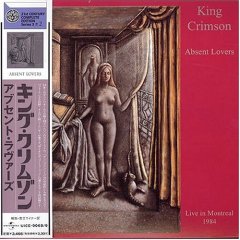
The last four shows of the 1981-84 King Crimson took place over the two nights of July 10th and 11th 1984 at Le Spectrum in Montreal. The performance on these albums are drawn from the final night, shortly after which King Crimson ceased to exist. Crimson was reborn on April 18th 1984 in Woodstock, New York; but that is another, and ongoing, story.
Production notes
Mixing a recorded studio performance is always a translation. Mixing a live performance is even more a translation, because it attempts to represent a wider event than can be contained within the studio.
David Singleton and I don't mix as such. Probably, a Ton Prob production presents a particular world-view. We are not neutral, nor purely responsive, nor can we quite direct the action: but all three are involved. Essentially, our aim is to be true to the musical event in its moment.
The key word to the Ton Prob production of Absent Lovers and one to which we keep returning, was 'definition'; not in the sens of limitation, but of clarification: by delineating the edges and containing the boundaries, spaces between are more clearly illuminated and the players thrown into the greater relief.
Generally, with regard to the presentation of live performances, this is not necessarily welcome to musicians whose idiosyncrasies conceits, illusions and failings may be revealed to the case of a critical ear. As one of the four musicians under present revelation, I am sympathetic; but responsibility to the larger translation holds my greater loyalty.
If, as in much recorded rock music, the studio album is viewed as a definitive text or score, then live performance is an interpretation of that text; and an album of live performance is only one particular translation of one specific interpretation, and that in a given context of time, place and person. So what is 'definitive'?
Firstly, the live performance of music is in its nature ephemeral. This, it shares with gardening. However, our experience of what is, on the surface, a relatively brief event may resonate in our lives to profound and continuing effect. Simply put, music can reach over and change our lives directly and immediately. Our experiencing takes place in sequential time, but is not always governed by it.
Secondly, if the continuing regard by members of a listening community for a particular performance, or performers, is worthy of attention, -and how could it not be?- then the curious may be willing to heed the interests of that community. Absent Lovers continues to be available as a bootleg thirteen years after the radio broadcast.
Thirdly, in a post-mortem world there is no one privileged position, translation nor interpretation. This necessarily implies that there are indeed privileged positions of translation and interpretation. This dictum applies, and otherwise, to the material interpreted by this incarnation of Crimson one evening in Montreal during July 1984.
If these comments seem to obscure the clarity which definition claims, I reply that clarity reveals a depth of perspective, a richness of potential, and a spectrum of experiencing within the material which may elude a surface examination. Or not.
Eitheer way, here it is.
The Group
There have been five different personnel configurations of the live King Crimson. The members of Lineup Four (1981/84) are: Adrian Belew: guitar, drums and lead vocal Robert Fripp: guitar Tony Levin: bass, Chapman stick, synth & vocal Bill Bruford: acoustic and electronic drums & percussion
The first performance, at Moles in Bath, was on April 31st 1981; the last at The Spectrum, Montreal, on July 1984. Live, the Tony, Ade, Billy & Bob Crimson were more song based than earlier versions of Crimson, but could also tear out and flatten ear hairs within a mile.
Each live Crimson has featured some aspect of new or current technology. This Crim featured two Roland GR300 guitar synthesisers, Chapman Stick and Simmonds electronic drums.
We recorded three studio albums. The material presented on this set is drawn from: Discipline (1981): Elephant Talk, Frame By Frame, Matte Kudasai, Discipline, Indiscipline, Thela Hun Ginjeet Beat (1982): Heartbeat, Waiting Man, Sartori in Tangier Three of a Perfect Pair (1984): Three of a Perfect Pair, Sleepless, Man With An Open Heart, Industry, Dig Me, Larks' Tongues In Aspic (Part III) Larks' Tongues In Aspic (1973): Larks' Tongues In Aspic (Part II) Red (1974): Red
DGM King Crimson Archive Series The Great Deceiver (1992): a 4 volume set of KC live in 1973/4, originally released through Virgin. This is currently out of print (February 1998) and has now reverted to DGM. We are planning to release a second edition of this in 1999. Epitaph (1997): a 4 volume set of KC, mainly live, in 1969. The Night Watch (1997/8): 2 volumes of KC at the Amsterdam Concertgebouw on November 15th 1973. Absent Lovers (1998): 2 volumes of the final show of the 1981-4 Crimson at The Spectrum in Montreal on July 11th 1984.
DGM plans to release other archive material, if there is sufficient expressed interest.
General Comments I
The aim in presenting this live performance is to reflect the spirit of the group in a moment of its appearance. Live recording is not a precise art. But then, neither is recording.
Here are some reflections on live recording, drawn from many years of experience:
1. The sound at the soundcheck bears no relationship whatsoever to the sound once the audience appear.
2. Distrust any musician who clams to give you their maximum level at soundcheck.
3. Microphones move from their original positions.
4. Drum microphones record everything, are occasionally used as percussion accessories, and occasionally record nothing at all.
5. Vocal microphones also record everything, except sometimes the singer.
6. The audience is a featured performer.
7. The foot is not an exact instrument of calibration when placed upon a volume pedal.
8. If a lighting person tells you their lights can't don't and won't cause buzzes on amplifiers or the sound system, spit on one, or both, of their feet and bite your thumb while shouting: 'The fig of Spain'
9. Tuning a guitar with whammy bar, but no string lock, can lead to a quarter-tone exchange between duetting guitarist-buddies. And if it might, it will. On live television.
"A whole range of listening assumptions has changed since Billy and the Boys banged and clattered in an auditorium now prohibited to rock groups. In 1973 the focal point for any stereo album was the centre, and the ideal place to listen right between the speakers. This was the norm from which all other judgements followed. The knobs on domestic hi-fi equipment were optimistically marked 'treble' and 'bass' (not 'thin' and 'dull') and panning was what critics did to performers. The responsibility for the sound to be heard by listeners (other than professional audients) belonged to the producer / mixer /engineer.
Today, who listens in the centre, live or at home? The majority of a concert audience continue to strain from the sides (as ever), and the common central listening position is on headphones. On contemporary mass-produced sound carriers the listener can re-organise their music with graphic equalisers and choos the venue - hall, church, dance hall or cinema - where they would prefer the music to be played.
This CD is presented to a post-modern world which has abandoned the simple, even simplistic, certainties of the musicians, and probably the audience, of the Concertgebouw on one evening in late 1973. The aim is to present the music of that night so that what was played is available to be heard, albeit in a manner of the listener's choice."