Showing posts with label Germany. Show all posts

Saturday, March 22, 2014

The Wall (Live in Berlin) - Roger Waters


One year after the fall of the Berlin Wall, Roger Waters and a bunch of other artists performed Pink Floyd's classical The Wall in Potsdamer Platz, a location where Eastern Berliners were shot for trying to go to West Berlin.

Over 350,000 people attended the concert, which was broadcast in 52 countries. The World was quite optimistic about the future back then and the massive scale of the show, still impressive almost 25 years later, is a testimony of that.

Since the aftermath of the show, Waters has been criticized for inviting pop musicians like Cyndi Lauper or Bryan Adams to perform. I think people who make that point completely misunderstand the purpose of this concert: this was not about music, but about providing The Wall with a completely new meaning, and I think Rogers succeeded on that: when people listen to "Another Brick in the Wall (Part 2)" today, they don't think about Pink's introspective processes, but about political repression and manipulation, something reminiscent to the Berlin Wall.

I highly recommend this video. As I said, the production is quite impressive, and the music is quite good, even if, I have to concede, Cyndi Lauper's performance is nonsense...

Thursday, June 13, 2013

Japan's Great Stagnation - Hans-Werner Sinn (ed.)

Edited in 2006 by Michael M. Hutchinson and Frank Westermann as part of the CESifo Seminar Series in Economic Policy, Japan's Great Stagnation presents 9 papers trying to explain the reasons behind Japan's prolonged economic downturn.

Though it might seem outdated, I recommend this book for three reasons:


  • Prophetically, the book's subtitle is Policy Lessons for Advanced Countries. In light of the recent developments taking place in the West since 2008, this book is a must read: the U.S. and Europe shouldn't spend more than 20 years with suboptimal growth.
  • In the introduction, Hutchinson, Ito, and Westermann mention that the Germany is the most likely country to follow Japan's steps. With hindsight, that statement was clearly a mistake: Germany is the only advanced economy growing at relatively decent rates. The Euro and the common monetary policy explains most of that: what the common monetary policy has implied is that the Greek people pay the lack of transparency of the German banks.
  • In their paper, Kunio Okina and Shigenori Shiratsuka argue that the zero interest rate policy failed because it was unable to change inflation expectations among bond traders. It is too early to say whether  Abenomics succeeded changing expectations, but if the developments of the last week are worth something, I'm afraid somebody will update Okina and Shiratsuka's work with more recent data...

Graph of Currency Exchange Rate - USD vs. JPY
The introduction touches tangentially the issue of misalligned property prices as one of the drivers of the economic crisis at the beginning of the 1990's. I think that the role of property prices in the economy has not recieved all the attention it deserves. Stephen Ceccheti issued a fantastic paper in 2008 on the topic, but I haven't too much since then. The BIS presents time series of property prices for free here.

Sunday, August 19, 2012

Out of Africa - Sidney Pollack

The Economist recently reported that Out of Africa is Angela Merkel's favorite movie. After watching it, I offer three possible explanations of Frau Merkel's taste for this movie:

1. Merkel identifies herself with Karen Dinesen (Meryl Streep), a tireless woman who is able to do a Safari on her own, run successfully a coffee plantation, and have a love story with a hunter.

2. A coffee plantation in Africa run by a white womAn who teaches Africans to read and have European manners is a simile for Merkel's vision of Europe when and if it overcomes the current financial crisis: she and the Germans would be able to finance their socialist state with the rents they would extract from the GIPSI countries as a result of successive rounds of rescue. In return, Frau Merkel and other law-abiding serious Germans would teach citizens from the GIPSI countries to become hardworking people (not Germans, but something close to it).

3. Merkel simply likes the love story between Karen Dinesen and Denys Finch (Robert Redford)

With its 2 hours and 40 minutes of duration, Out of Africa is also the testimony of a bygone era of film making. At the time of its release (1985) relatively long movies were not uncommon.  Competition with other media was not an issue back in the day, so studios could invest in long movies and directors could develop their stories fully, especially if a movie was based on a book.  Dances with Wolves took these two concepts to the extreme with its 4 hours of duration. Home theater, DVDs, HBO and Netflix changed that radically: complex histories are now told in series, and movies are usually 2 hours shots of superficial stories for wide audiences.

For some reason, youtube has the full movie online. I embed the video right below:


Monday, March 5, 2012

Jules et Jim - Francois Truffaut

Je pense que je suis la première personne qui catalogue Jules et Jim comme un film de science fiction, mais je vais vous expliquer pour quoi je l'ai fait. Jules et Jim racconte l'histoire d'un triangle amoureux, mais c'est davantage le portrait de l'amitié entre un Francais et un Autrichien. Et c'est précisément pour cela que Jules et Jim est un ouvrage de science fiction irréalisable, comparable aux livres classiques de Jules Verne: la crise économique de la zone euro actuelle montre que les pays du Nord de l'Europe (l'Allemagne, les Pays Bas, l'Autriche, et les pays Scandinaves) sont incapables de subir à l'amitié ou  à la solidarité. Quel roman est-il l'équivalent Allemand ou Scandinave du Quichotte, example universel de noblesse et d'amitié sans limites? Et des Trois Mousquetaires, le roman qui parle sur la loyauté le plus connu du Monde? Il n'y en a pas, mesdames et messieurs.


Pour des raisons culturelles, géographiques, et socio-politiques, les pays du Nord ne connaissent pas de l'amitié ou de la solidarité. Les pays du Nord de l'Europe ont profité énormément du mauvais dessin de l'Euro et maintenant que la situation a éclaté ils regardent vers l'horizon et vendent l'idée que les habitants du pays du Sud sont tous des flâneurs.


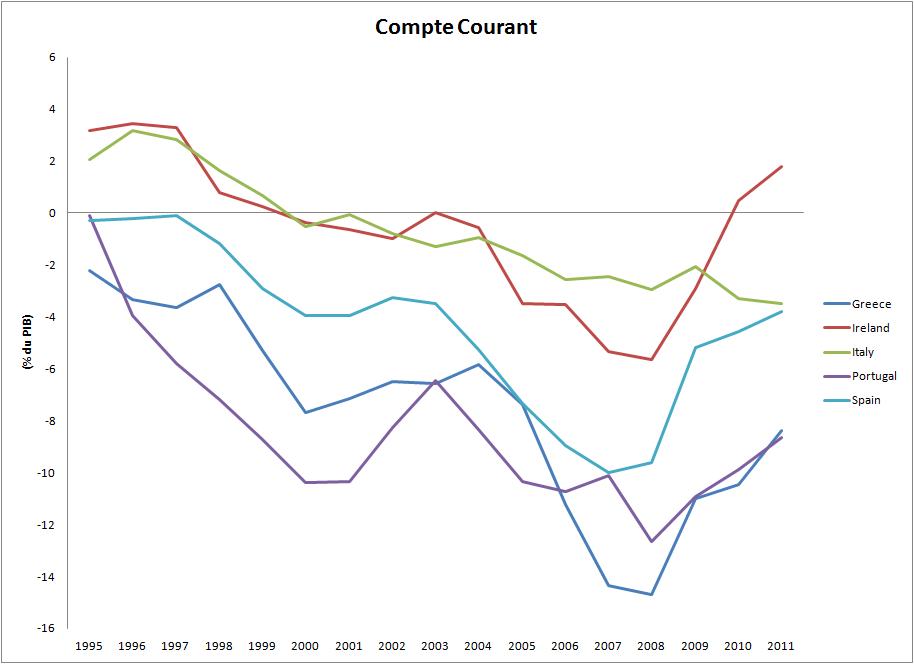
Il faut d'abord rappeler que les pays du Nord étaient débiteurs avant 2003 et sont dévenus créditeurs immédiament après l'entrée de l'Euro. Or, les pays du Sud, qui étaient compétitifs en partie grace à leur taux d'échange vis-à-vis l'Allemagne, ont commencé à importer plus que ce qu'ils vendaient à l'extérieur, ce qui a ouvert un cercle vicieux d'endettement: si on pouvait décomposser les importation des pays du Sud, ont verait qu'ils ont commencé à importer des produits provenant du Nord (vous pouvez le faire vous même à Eurostat) et a emprunter aux banques Allemandes et Francaises (vous pouvez en servir aussi au BIS). Il faut noter aussi  que le comportement du compte courant de la France resemble plus à celui des pays du Sud qu'a celui du Nord, sauf que, au différence des pays GIPSI, l'ajustement n'y a pas commencé. La belle vie n'est pas finie en France, mais pour combien de temps continuera-t-elle?


Nos "amis" Allemands ont du mal a comprendre ces charts, ce qui ne parle très bien de leur système éducatif,  même s'ils le présentent comme l'un des meilleurs du Monde. 


Les habitants du pays du Nord, ou au moins leurs classes politiques et intellectuelles, n'hésitent pas un instant à diffuser l'idée que les pays du Sud profitent de leur génerosité, ce qui est un autre mensonge. L'Allemagne et l'Autriche peuvent aller aux marchés financiers et placer leurs bonds a un taux d'intérêt près du zero, donc négative en terms réels. Ce qu'ils font avec cet argent c'est capitaliser le Fonds Européen de Stabilité Financière, qui a donné des prêts vers l'Irlande et le Portugal au taux moyen de 5.3%. Voilà; la "solidarité européenne" n'est qu'une masque, une excuse, pour que les citoyens du Nord de l'Europe fassent un business au profit de 500%.  


Mais ce n'est pas tout. Ce qui est épouvantable c'est que les Allemands et ses "amis" Néerlandais et Autrichiens, pas conformes avec dégrader leurs parténaires Grecs, Espagnols, Italiens, et Portugais, autour du Monde, veulent que des pays en voie de développement comme la Chine ou le Brésil soient les financiers du sauvetage de la banque et des souverains européens via le Fonds Monnétaire International. 


À tous ces faits, nos "amis" du Nord de l'Europe répondent que les pays du Sud ont menti en ce qui concerne leurs chiffres du déficit gouvernamentale. Cela est vrai, mais l'histoire montre que on arrange les crises de dette extérieure via une dévaluation. Si cette option n'est pas disponible, comme il est le cas en Europe, il faut faire un bail-out aux gouvernements, et pas aux banques, comme la Banque Centrale Européenne l'a fait deux fois déjà dans les derniers trois mois.


Les Allemands sont les pires leaders de l'histoire. Ils sont les seuls à avoir le poids politique et économique pour résoudre cette crise, ce qui veut dire payer les dettes des pays du Sud, ce qui veut dire faire un bail out des banques Allemandes et Francaises, ce qui veut dire assurer les pensions des citoyens Francais et Allemands.


Sinon, Jules et Jim est un très bon film, même si la fin est extrêmement décevante, et même si, aujourd'hui on pense que ce film est l'histoire d'une dominatrix et ses deux joujous, et pas celle d'une femme amoureuse de deux hommes parfaits.


NOTE: Le source des charts est la base de données WEO September 2011 du FMI. Les projections commencent à partir de 2011.

Sunday, February 12, 2012

The Mortal Storm - Frank Borzage

During the Cold War, it was easy for movie studios to produce movies bashing the USSR or China: their movies were forbidden there anyway, so any viewers in those countries were seen as potential consumers. During the years of McCarthyism, producing an anti-Communist film also represented not being in the black list and having government subsidies. A similar logic applies today with movies praising the heroism of American soldiers or anything that presents Iranians or Middle-Eastern Muslims like a bunch of fanatics: by producing movies like the Iron Man saga, or Charlie Wilson's War, Hollywood studios aren't taking a stance, but making profits and creating fertile soil for prospect markets -because, of course, the Middle East eventually become a region full of American-style democracy where everybody will love Hollywood movies.

Hollywood is not very good at going against mainstream political opinions. Back in the 1930s, once political persecution and concentration camps became common in Germany, Hollywood remained silent. Germany was the second largest market for American movies in the World, so too much money was at stake. Also, political repression affected only communists, or so thought people back in the day. Charles Chaplin was one of the first persons to take a clear stance against Nazism with The Great Dictator (which he produced with his money, by the way), but the only studio that took an official position against Hitler before anti-Nazism was profitable was Metro-Goldwyn-Mayer with The Mortal Storm. This is a movie worth watching, if nothing else because it shows that corporations can do the right thing for moral reasons rather than for accounting profits (here is the IRS' list of authorized charities, in case you got to this post by mistake). 

This is a movie about a family breaking apart after Hitler's raise to power. The family is composed by Professor Roth, a "non-Aryan", his Junker wife, the two sons of her previous marriage, and the two children of the couple: Freya (played by Margaret Sullavan), and a boy. The two sons and Freya's fiancé join the Nazi Party after Hindenburg appoints Hitler as Chancellor, changing the dynamics of the family. A once calm and nice German town next to the Alps suddenly becomes enthralled with Nazism and its promise to restore Germany's greatness, which is funny when you think that modern Germans claim that "nobody knew" what was really going on in the concentration camps. 

This is an anti-Nazi propaganda film and has no intention to show anything close to objectivity. With the exception of Professor Roth, his wife, and Freya, Germans are shown as relentless machines of destruction, a view that is somewhat vindicated today (2012) given the attitude of average Germans towards their Greek fellows. In the movie, Germans are shown beating a Jewish elder man en masse, burning books, boycotting science classes, and willing to shoot their beloved ones for the sake of the Führer. As it happens, all of this turned out to be true, but in the 1930s only the communists and the Jewish established in the United States said it.

The end is probably the most interesting part of the movie. (SPOILER FOLLOWS) There is a non-written rule in Hollywood that endings must be happy. The obvious Hollywood-style end of the movie is that the family to move to The Land of The Free and The Home of The Brave. Alas, Professor Roth dies in a concentration camp, Freya is shot under the orders of his fiancé, and the two Nazi brothers have a shivering dialogue. One can only guess to what extent MGM was against Nazism that it was willing to break the convention and having a sad (and therefore more impacting) end.

The trailer of The Mortal Storm is here: